
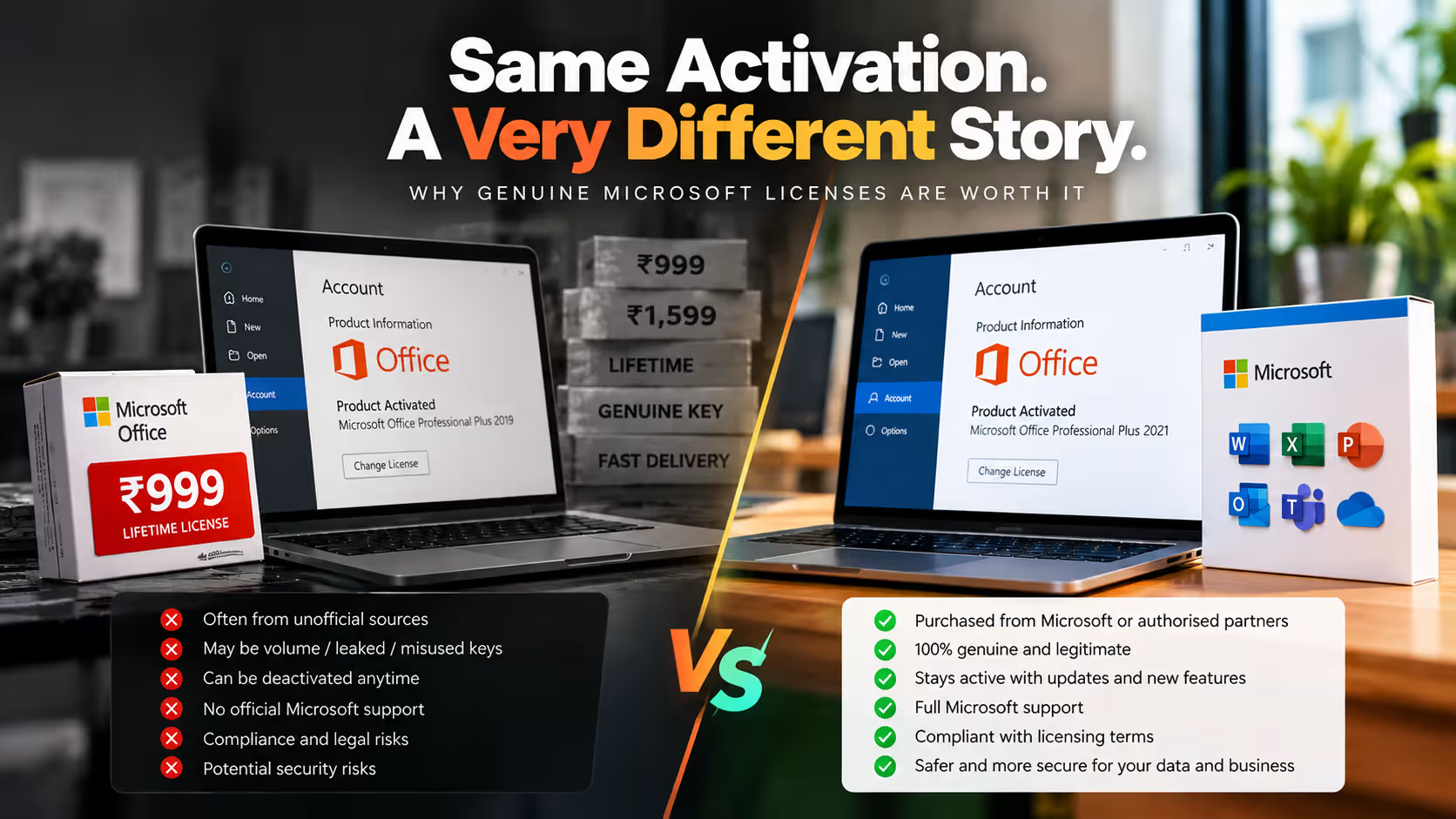
Genuine vs Cheap Microsoft Licences: Why a ₹999 Key Can Cost You More
Cheap Windows and Office keys can activate successfully. But activation alone does not establish that you own a valid licence. Here is what the price difference means, what can go wrong later, and how to make a safer purchasing decision.
Illustrative price examples, not current market quotations. Microsoft licence prices vary by product, edition, channel, subscription term and seller.
A product key is a mechanism used to install or activate software; it is not, by itself, proof that the buyer has the legal right to use that software. A low-priced key may come from a legitimate discounted or transferable licence arrangement, but it may also be misrepresented, restricted to another channel, already overused or otherwise unauthorised. The price alone cannot establish which is true. What matters is the licence entitlement, its terms, its provenance and the evidence of purchase.
Search for Windows 11 Pro or Microsoft Office online and you may see product keys advertised for ₹999, ₹1,599 or similarly low prices. The listings often promise instant delivery, lifetime activation and a few simple installation steps.
For a buyer comparing prices, the question is obvious: if the cheap key activates Windows or Office just like a more expensive purchase, why pay more?
The answer is that software activation and software licensing are related, but they are not the same thing. Activation is a technical process. A licence defines the rights you have to use the software. Those rights depend on the applicable Microsoft terms and the specific product and distribution channel.
To understand the difference, we need to look beyond the activation screen.
1. Why are some Microsoft licences so cheap?
There is no single explanation for every inexpensive key. Several very different products and arrangements can be advertised using the same phrase: “genuine Windows key” or “original Office licence”.
Legitimate differences in licensing
Microsoft software is sold through different channels, including original equipment manufacturer (OEM), retail and commercial licensing arrangements. These can have different prices, transfer rights, deployment options and usage restrictions.
- OEM licences: Windows may be supplied with a new computer. These licences are generally tied to the device under the applicable terms.
- Retail licences: These are sold to end customers and have their own transfer and usage conditions.
- Commercial licences: Organisations may acquire software through eligible business licensing programmes, subject to programme-specific terms.
- Subscriptions: Microsoft 365 plans provide software and services for a defined subscription period, with benefits depending on the plan.
These differences can explain why two legitimate offers do not have the same price. However, a seller cannot make an otherwise unauthorised key legitimate merely by calling it an OEM, retail, volume or lifetime licence.
When an unusually cheap key deserves scrutiny
Some sellers offer keys without clearly explaining their original source, applicable licence terms or restrictions. Possible problems include:
- Keys obtained through stolen payment details or fraudulent transactions.
- Keys intended for a different licensing programme, organisation or deployment scenario.
- Keys that have been reused or distributed beyond the permitted number of devices.
- Keys supplied under terms that do not permit the advertised resale or use.
- Genuine keys sold without the underlying licence rights or adequate evidence of entitlement.
Microsoft specifically warns that product keys sold separately through questionable online listings may be stolen, counterfeit or otherwise unauthorised, and that some keys may subsequently be blocked.
A low price does not automatically mean a licence is invalid. Equally, a key that activates successfully does not automatically mean the transaction was legitimate. Evaluate the actual licence rights and supporting documentation rather than relying on price or activation status alone.
2. Why do cheap keys activate if something is wrong?
This is the part that confuses many buyers. They enter a key, Windows displays an activation confirmation, or Office opens without an activation warning. Everything appears to work.
There is a technical reason: Microsoft's activation systems support multiple licensing channels and activation methods. A key can be accepted by an activation system without the activation screen establishing every aspect of the buyer's entitlement or the seller's authority to distribute it.
Consider a few examples.
Scenario A: A key is accepted but its source is questionable
A key may initially activate because it is technically valid for the relevant activation process. If the key is later identified as stolen, fraudulently obtained or improperly distributed, it may be blocked. The buyer may then need to contact the seller, seek a refund and acquire a properly licensed replacement.
Scenario B: The key belongs to a different licensing arrangement
Some keys are associated with organisational or other restricted licensing arrangements. The ability to activate does not, by itself, establish that an individual or unrelated business has the right to use the software under those terms.
Scenario C: The software is genuine, but the entitlement is not transferable as advertised
A key might originate from a genuine software distribution channel while the seller's claims about resale, device transfers or permitted use are inaccurate. The relevant licence terms determine what the purchaser is entitled to do.
In all three scenarios, the key takeaway is the same: the activation result is not a substitute for verifying the licence.
3. What happens after activation?
There is no universal sequence of events for every low-cost key. Some may continue to work; others may encounter problems immediately or later. The following are possible outcomes, not inevitable consequences of buying an inexpensive key.
The key may continue working
A key that remains functional is not necessarily proof that the licence was properly transferred or sold. Technical functionality and licensing entitlement must be evaluated separately.
The key may be blocked or activation may fail later
If Microsoft blocks a key or the software no longer accepts its activation, the user may encounter activation warnings, restrictions or a need to obtain a replacement licence. The exact effect depends on the product and circumstances.
You may struggle to obtain a refund
If a seller disappears, refuses to cooperate or offers no meaningful support, recovering the purchase price can be difficult. A very low initial cost can become a recurring expense if the user has to purchase the software again.
A company may face a licensing compliance problem
Businesses need to be able to establish that their software use is covered by appropriate licences. If the organisation cannot substantiate its entitlement, it may have to investigate, correct the shortfall and acquire suitable licences. The consequences depend on the facts, the applicable agreements and the relevant legal framework.
The seller may not provide dependable support
A marketplace listing that promises “lifetime support” does not necessarily provide the assistance available through the legitimate seller or applicable Microsoft support arrangements. Support eligibility depends on the product, licence and service terms.
Do not assume that every improperly licensed Windows installation immediately stops receiving all security updates. Microsoft's guidance distinguishes critical security updates from certain updates and benefits reserved for genuine software. Update availability, activation status and licence entitlement are related but separate considerations.
4. The hidden cost of a cheap licence
The real comparison is not simply ₹999 versus a higher purchase price. It is the initial price plus the potential cost of replacement, troubleshooting, downtime and the time spent resolving a dispute.
| Consideration | Unverified low-cost key | Properly sourced licence |
|---|---|---|
| Initial price | Often attractive | Depends on product and channel |
| Activation | May activate successfully | Should follow the applicable activation process |
| Proof of entitlement | May be missing or inadequate | Purchase and licence records can support verification |
| Usage rights | May be unclear or misrepresented | Established by the applicable licence terms |
| Future reliability | Uncertain if the source is questionable | Lower sourcing uncertainty when purchased correctly |
| Business records | May not adequately support compliance checks | Can be retained for asset and licence management |
| Support and recourse | Depends heavily on the seller | Depends on the seller, product and support terms |
A properly sourced licence does not guarantee that no technical issue will ever occur. Its advantage is that the purchaser has a defensible basis for use and a clearer path to resolving licensing questions.
5. Why businesses should be especially careful
For an individual using one personal computer, an uncertain licence can be an inconvenience and an avoidable expense. For a company with several employees and multiple devices, the same uncertainty can become an operational and administrative problem.
Software asset management
A business should know which Microsoft products it uses, how many devices or users are covered, which licence types apply and where its proof of purchase is stored. A collection of unrelated product keys from different online sellers makes that process harder.
Procurement and accounting
Companies need purchasing records that can be reconciled with their software inventory and internal policies. A low price is not a sufficient procurement justification if the source, entitlement or usage rights cannot be established.
Employee onboarding and device replacement
When employees join, leave or receive replacement computers, the organisation needs to understand which licences can be reassigned and which are tied to particular devices or users. Those decisions depend on the licence terms, not simply on whether a key is available.
Audits and compliance reviews
A company may be asked to demonstrate that its software deployment is appropriately licensed. It should be able to produce relevant agreements, order records, invoices and entitlement information where applicable. An activation screenshot alone may not establish those rights.
Business continuity
Standardising procurement and maintaining accurate records reduces uncertainty during device replacement, software deployment and compliance reviews. This is particularly important when several employees rely on Microsoft applications for everyday operations.
6. Why individuals should also buy genuine licences
Individuals have good reasons to verify software purchases even when they do not operate a business.
- Avoid repeat purchases: An improperly sourced key may need to be replaced.
- Know your rights: Understand whether the licence is tied to a device, transferable under its terms or associated with a subscription.
- Protect your work: Avoid unnecessary disruption when using Office for studies, personal projects or professional work.
- Reduce uncertainty: Buy from a credible source that can explain the product and provide appropriate purchase records.
- Get the right product: Make sure the edition and licence match your actual requirements.
If your budget is limited, compare legitimate editions and plans rather than assuming that the cheapest product key is the best option. Microsoft also provides free web-based Word, Excel and PowerPoint experiences through Microsoft 365 on the web, subject to the available features and account requirements.
7. How to check a Microsoft licence before buying
Before paying for Windows, Office or Microsoft 365, use the following checklist.
- Identify the exact product. Confirm the edition, version, number of users or devices and whether the offer is perpetual or subscription-based.
- Ask what licence you are buying. Request the applicable channel, licence terms, transfer conditions and any restrictions.
- Verify the seller. Prefer Microsoft or a credible reseller that can explain the source and entitlement. Check any claimed partner status independently.
- Request proper documentation. Retain the invoice or receipt, order details and relevant licence or entitlement records. The exact documents depend on the product and channel.
- Be cautious with standalone keys. Microsoft warns that keys sold separately through questionable listings may be unauthorised or blocked later.
- Confirm the intended use. A personal licence, an OEM licence and a commercial licensing arrangement may have different rights and restrictions.
- Keep the records. Store purchase evidence and licence details so you can retrieve them if you reinstall software, replace a device or conduct a compliance review.
For additional guidance, consult Microsoft's official resources:
- About Genuine Windows — Microsoft Support
- Stay Safe with a Genuine Office Licence — Microsoft Support
- How to Tell and Shop for Genuine Microsoft Software
- Microsoft Learn — Volume Activation Planning
8. What should you buy: Windows, Office or Microsoft 365?
The right choice depends on what you need, how you work and the applicable licence terms. These products are not interchangeable.
Windows 11
Windows is the operating system. Confirm the edition you need, whether your computer already has a qualifying licence and whether the offer is appropriate for your device and intended use.
Office perpetual licences
Certain Office editions are purchased for use under perpetual licence terms. Perpetual does not mean every future Office version is included, nor does it mean that every key advertised as “lifetime” provides a valid licence.
Microsoft 365 subscriptions
Microsoft 365 is a subscription service with features that depend on the selected plan. Depending on the plan, it may include desktop applications, cloud storage, collaboration capabilities and ongoing feature updates. The subscription must remain valid to retain subscription-dependent benefits.
Businesses should compare licence requirements, user counts, deployment needs, security features and ongoing costs before making a purchasing decision.
9. The IndWerk Labs approach to Microsoft licensing
At IndWerk Labs, we believe software procurement should be based on the right product, the right licence and a clear understanding of what the customer is purchasing—not simply the lowest advertised key price.
For businesses evaluating Microsoft software, a structured procurement process can help clarify:
- Which Microsoft products and editions are suitable for the organisation.
- How many users or devices need to be covered.
- Which licensing options fit the intended deployment.
- What documentation should be retained for purchasing and software asset management.
- How to compare upfront costs with subscription or longer-term licensing requirements.
IndWerk Labs supports business software procurement and technology requirements. We recommend verifying the applicable product terms and entitlement before completing a purchase.
Frequently asked questions
Is a ₹999 Windows 11 Pro key genuine?
The price alone cannot determine whether a key is genuine or properly licensed. Some discounted offers may be legitimate, while others may involve restricted, misrepresented or unauthorised keys. Verify the seller, licence terms, source and supporting documentation before purchasing.
If Windows says it is activated, does that prove the licence is genuine?
No. Activation is a technical process and does not, by itself, establish every aspect of the buyer's licence entitlement. You should also verify the licence terms and purchase records.
Can a cheap Microsoft key stop working later?
Yes, this is possible. A key may be blocked if it is found to have been stolen, fraudulently obtained or otherwise improperly distributed. However, not every low-priced key will necessarily fail.
Will Windows stop receiving all security updates if the licence is not genuine?
Not necessarily. Microsoft states that non-genuine Windows can still receive critical security updates, while certain other updates and benefits may be limited. Do not rely on this as a substitute for obtaining a properly licensed copy.
Can a company use cheap keys if they activate successfully?
Activation alone is insufficient to establish that a company has the required rights. The organisation should verify the applicable licensing terms, entitlement, device or user coverage and supporting records before deploying software.
Is an OEM licence the same as a retail licence?
No. OEM and retail licences can have different acquisition, transfer and usage conditions. Check the specific product terms before purchasing or moving a licence to another device.
Is a lifetime Office key the same as Microsoft 365?
No. A perpetual Office licence and a Microsoft 365 subscription are different offerings. Their included applications, services, upgrade rights and usage conditions vary. Confirm exactly what the seller is offering.
What is the safest place to buy Microsoft software?
Buy directly from Microsoft or through a credible reseller that can substantiate the applicable licence entitlement. Microsoft recommends purchasing from Microsoft or a trusted, authorised source. Verify any reseller's claimed status and retain your purchase records.
What should I do if I already bought a suspicious key?
Keep your order confirmation and seller communications, ask the seller to substantiate the licence and request a refund if the offer was misrepresented. Check Microsoft's official guidance and acquire a properly licensed replacement if necessary.
Does genuine Microsoft software always cost the same everywhere?
No. Pricing varies by product, edition, subscription term, licensing channel, market and seller. A legitimate business or retail offer may differ in price, but its licence terms and entitlement should be clear.
Conclusion: Buy the licence, not just the key
A low-cost Microsoft key may look like a bargain because it can activate the software immediately. But the activation screen does not tell you everything about where the key came from, what rights accompany it or whether the seller was entitled to offer it to you.
For individuals, verifying the licence helps reduce the risk of repeat purchases and unexpected activation problems. For businesses, it also supports sound procurement, accurate software inventories and better licensing compliance.
The sensible approach is not to assume that every cheap key is illegitimate or that every expensive purchase is automatically correct. It is to verify the product, the source, the licence terms and the entitlement before buying.
When purchasing Microsoft software, make the decision on verified licensing rights—not on the activation message or the price tag alone.
- Microsoft Support: About Genuine Windows
- Microsoft Support: Genuine Office Licensing
- Microsoft: How to Tell — Shop
- Microsoft Learn: Volume Activation
This article provides general software licensing information and is not legal advice. Licensing rights and requirements depend on the specific product, agreement, channel and applicable terms.