
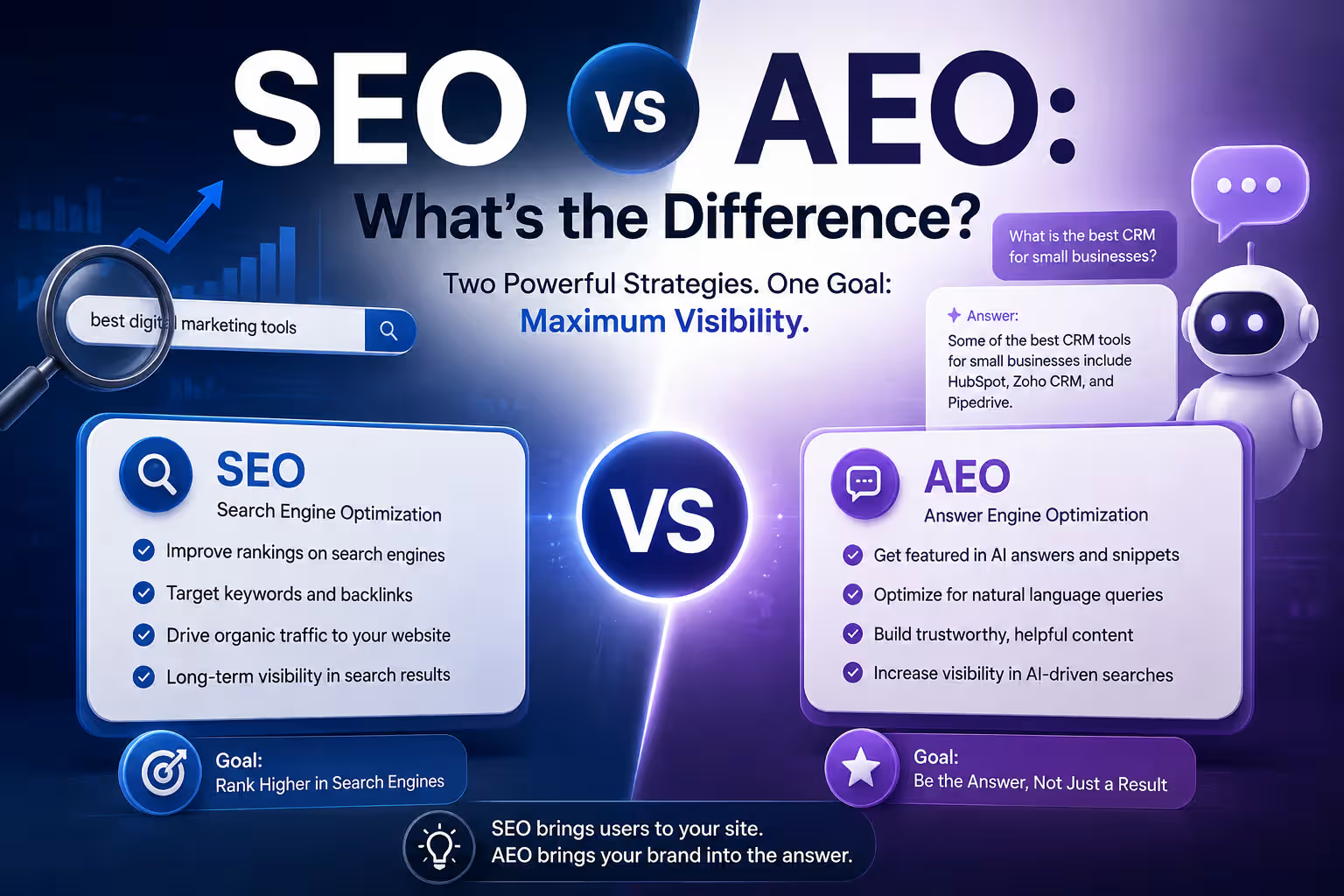

SEO vs AEO: What's the Difference?
SEO helps your website become more visible in search engines. AEO focuses on making your content useful and understandable enough to be selected as an answer. In 2026, businesses increasingly need to think about both.
SEO and AEO are related, but they are not the same. SEO, or Search Engine Optimisation, focuses on improving a website's visibility in search results. AEO, or Answer Engine Optimisation, focuses on structuring information so that search engines, AI systems and answer-focused interfaces can understand and use it when responding to questions.
SEO is primarily concerned with being discovered and ranked. AEO places greater emphasis on being understood, trusted and selected as a useful answer.
The practical approach for most businesses is not to choose one over the other. A strong website should use SEO as the foundation and AEO as an extension of its content and information strategy.
What Is SEO?
SEO stands for Search Engine Optimisation.
It is the process of improving a website so that search engines can discover, understand and rank its pages for relevant searches.
SEO can involve many different areas, including:
- Keyword research
- Content optimisation
- Technical SEO
- Internal linking
- Page structure
- Site speed and performance
- Mobile usability
- Structured data
- Image optimisation
- Backlinks and authority
- Local SEO
The overall objective is relatively straightforward:
Make the website easier for search engines to understand and more useful for people searching for relevant information.
What Is AEO?
AEO stands for Answer Engine Optimisation.
AEO focuses on improving how clearly a website communicates information that could be used to answer questions.
This becomes particularly relevant as people increasingly interact with:
- AI assistants
- AI-powered search
- Conversational search interfaces
- Featured answers
- Voice assistants
- Question-based search
Instead of only thinking about keywords, AEO encourages businesses to think about the questions their customers actually ask.
For example, a web development company may not only target:
It may also create useful content around questions such as:
The objective is to provide clear, direct and context-rich information that can be understood by both humans and machines.
01. SEO and AEO Have Different Primary Goals
The easiest way to understand the difference is to look at the primary objective of each discipline.
| SEO | AEO |
|---|---|
| Improve search visibility | Improve answer visibility and usability |
| Target relevant searches | Address specific questions and information needs |
| Focus strongly on rankings | Focus strongly on being understood and selected as an answer |
| Optimise pages for search engines and users | Structure information for search engines, AI systems and users |
| Often targets keywords and topics | Often targets questions, entities, context and intent |
02. SEO Is Not Being Replaced by AEO
One of the biggest misconceptions around AEO is that businesses need to abandon SEO and replace it with AEO.
That is not how it works.
AEO builds on many of the same fundamentals that make a website strong for SEO.
A website still needs:
- Accessible pages
- Good technical performance
- Useful content
- Clear page structure
- Logical internal linking
- Reliable information
- Strong user experience
- Appropriate structured data
AEO therefore should be viewed as an additional layer rather than a complete replacement for conventional SEO.
03. The Difference Is Also About Search Intent
Traditional SEO often begins with keywords.
AEO encourages a broader view of search intent and information needs.
Consider someone searching for:
A conventional SEO strategy might create a page targeting that keyword.
An AEO-oriented strategy would ask additional questions:
- What does the person actually want to know?
- Are they looking for a price range?
- What factors affect the cost?
- Are they comparing agencies?
- Do they need ecommerce?
- Are they asking about India specifically?
- What should they expect to pay for maintenance?
The resulting page can answer the broader information need instead of simply repeating a target keyword.
04. AEO Favors Clear Answers
AEO content generally benefits from being direct.
If someone asks:
"How much does a business website cost in India?"
The page should not make the reader go through 1,500 words before finding the answer.
A better structure might be:
Quick Answer
Give the reader a concise answer first.
Then explain
Explain the factors that affect the answer, provide examples, and add relevant context.
This structure is useful for humans as well as systems attempting to understand the content.
05. Structure Matters More for AEO
AEO places significant emphasis on how information is organised.
A page should make relationships between pieces of information clear.
Useful elements can include:
- Descriptive headings
- Short explanatory paragraphs
- Lists
- Tables where appropriate
- FAQs
- Definitions
- Step-by-step explanations
- Examples
- Relevant structured data
This does not mean every page needs an FAQ section or a collection of schema markup. Structure should reflect the actual information being presented.
06. Entity and Context Become More Important
Modern search systems increasingly need to understand entities and relationships, not just individual keywords.
For example, a business website should clearly communicate:
- Who the business is
- What services it provides
- Where it operates
- Who it serves
- Which industries it works with
- What products or technologies it uses
- How its services relate to one another
This creates a clearer information model around the business.
Instead of simply mentioning "SEO" dozens of times, a business can explain what SEO means, what services it provides, who those services are for, and how they relate to other services such as AEO, content strategy and website development.
07. FAQs Can Help, but They Are Not a Magic Trick
FAQs are commonly associated with AEO because many searches are phrased as questions.
A well-written FAQ can be useful when it answers genuine customer questions.
For example:
Does WordPress require maintenance?
Yes. WordPress websites should receive regular software updates, backups, security checks and performance monitoring.
But adding twenty artificial questions to every page simply to create an FAQ section is not a meaningful AEO strategy.
Useful answers matter more than the number of questions.
08. Content Quality Still Matters
AEO does not eliminate the need for good content.
In fact, the opposite is true.
Businesses need content that is:
- Accurate
- Specific
- Original
- Relevant
- Well structured
- Easy to understand
- Supported by appropriate evidence where necessary
Simply producing large volumes of AI-generated articles is not an AEO strategy.
A website should provide information that genuinely helps the intended audience.
09. SEO and AEO Work Best Together
The strongest approach is usually not SEO versus AEO.
It is SEO plus AEO.
SEO helps people discover the website.
AEO helps the website communicate its information in a way that is more suitable for question-driven and answer-driven search experiences.
Both ultimately depend on the same fundamental principle:
Create useful information and make it easy to understand.
10. What Should a Business Do in 2026?
Businesses do not necessarily need a completely separate "SEO website" and "AEO website."
Instead, the existing website can be improved in layers.
Start with technical SEO
Make sure the website is crawlable, fast, mobile-friendly and technically sound.
Build useful service pages
Clearly explain what the business offers, who it serves, where it operates, and why customers should consider it.
Create question-based content
Identify genuine questions customers ask before buying and create useful content that answers them.
Improve information structure
Use descriptive headings, logical internal links, concise answers, examples and appropriate structured data.
Demonstrate expertise
Use original insights, case studies, examples, author information, company details and credible supporting information where appropriate.
SEO vs AEO: Which One Should You Choose?
If you are running a business website, the answer is usually:
You should not have to choose.
SEO remains important because people still use traditional search engines to discover businesses, products and information.
At the same time, search behaviour is becoming more conversational and increasingly influenced by AI-powered interfaces.
That means businesses should prepare their content for both discovery and understanding.
| If your goal is... | Focus on... |
|---|---|
| Getting discovered in search | SEO |
| Answering customer questions | AEO |
| Improving technical website health | SEO |
| Making information easier to understand | AEO |
| Building long-term search visibility | SEO + AEO |
Final Verdict
SEO and AEO are not competing strategies.
SEO focuses primarily on helping websites become discoverable and competitive in search. AEO focuses more heavily on making information clear, structured, useful and suitable for answer-driven search experiences.
For businesses in 2026, the practical approach is to build a strong SEO foundation and then make the website increasingly useful for question-based and AI-assisted discovery.
That means better content, clearer answers, stronger information architecture, useful FAQs, accurate business information and appropriate structured data.
SEO helps people find you. AEO helps systems understand what you can answer.
Frequently Asked Questions
What is the difference between SEO and AEO?
SEO focuses on improving a website's visibility in search results. AEO focuses on making information clear and structured so that it can be understood and potentially used as an answer by search engines, AI systems and other answer-focused interfaces.
Is AEO replacing SEO?
No. AEO is better understood as an extension of modern search optimisation. Technical SEO, content quality, website performance and authority remain important foundations.
Is AEO important for businesses in 2026?
It is increasingly relevant as users interact with AI-powered search, conversational interfaces and question-based discovery. Businesses can prepare by making their information clear, accurate, useful and well structured.
Does AEO mean adding lots of FAQs to a website?
No. FAQs can be useful when they answer genuine customer questions, but simply adding large numbers of artificial questions does not create a strong AEO strategy.
Is structured data important for AEO?
Appropriate structured data can help search systems understand certain types of information, but schema markup alone does not guarantee visibility in AI or search results. It should support a well-structured website rather than replace good content.
Can WordPress be optimised for both SEO and AEO?
Yes. WordPress provides control over page structure, content, internal linking, structured data, FAQs and publishing workflows, making it suitable for implementing both SEO and AEO strategies.
What should a business focus on first: SEO or AEO?
Start with a solid technical and content SEO foundation. Then improve the site's ability to answer specific questions and communicate business information clearly. In practice, SEO and AEO should develop together.